Posts

Showing posts with the label science

Darwin Day is today

Image
Even though it's old and faded, this is one of my favorite T-shirts. It commemorates the day of Charles Darwin's birth, 200 years ago---and that just happens to be today, February 12th. Darwin Day

Nerd Crossing

Image
Do you think that's funny? You can find it at this address . The guy that creates them, Randall Munroe, is a CNU graduate with a degree in physics so he knows about the geek-thing first hand. A lot of his comics, but not all, deal with the math / science / physics area especially how scientists and non-scientists interact with one another.

...a couple of problems away

Image
The title up there is taken from a quote by Craig Grimes , a professor of electrical engineering at Penn State University. According to Grimes, his group is “only a couple of problems away” from developing an inexpensive and easily scalable technique for water photoelectrolysis (the splitting of water into hydrogen and oxygen using light energy) that could help power the proposed hydrogen economy. As you probably know, methods of hydrogen production currently employed split hydrogen from natural gas in a process that produces CO2, which is a climate changing greenhouse gas. Since hydrogen is abundently available in water (H2O) it would be much better--and cheaper--if we could extract it from water at a reasonable cost. You can do it now by running electrical current through water but it's not very efficient. The Penn State scientists speculated that by doping a TiO2 (titanium oxide, a common ingredient in white paint) film with a form of iron called hematite, a low band gap semico...

Wnt, aging, and the fountain of youth

Image
You're not getting any older--just your blood is. LOL The story is actually a lot more complicated than that but there's two articles in the August 10 issue of Science that indicate that the environment (ie blood) our cells are in is a lot more important vis a vis aging than the cells themselves. Further, that it's a protein referred to as wnt that is the big player in this. Wnt has long been known to be a very important regulatory protein. The name is derived from "wingless" and "integrative" and dates back to early genetic work on fruit flies on the wingless side and vertebrate studies on the integrative. As you can see to the left, the wnt pathway is complex. My research has dipped into the APC area quite a few times and one of the genes I'm working on right now is for a frizzled protein (the FRZ in the diagram) but I've never worked with wnt directly. Back to the Science article. Thomas Rando, MD, PhD, associate professor of neurology a...

Genetics and the Eucalyptus tree

Image
I've got a story below that's off of the Reuters' science wire. It sparked a few thoughts in me about science and genetics and nature. According to this news item, there's a big push starting to determine the genetics of the Eucalyptus tree. The stated benefits include developing trees that respond better to stressors like salt and aridity as well as improved hardness and density of the wood itself. However they also stress that they aren't going to make any genetic changes to the tree, just catalog the genes. My question is how are you going to reap those benefits without changing the tree? LOL Of course you can't. My point here is that many people are concerned when they hear that an organism is having it's genotype changed yet that's what we've been doing for thousands of years. Dogs used to be wolves. Not anymore. The list of genetically modified critters and plants is long and very advantageous to mankind. We've just been doing it by incest...

chloroform and you

Image
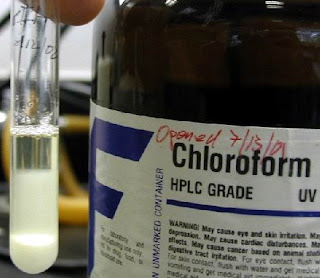
Last week one of the techs here dropped a bottle of chloroform on the floor. She's a ditz and asked me if she should do anything. I told her it was quite volatile and would disappear on its own quite well but that she might want to stand somewhere else--she was standing in the puddle of chloroform--or she might find herself passing out soon. I'm not sure why she was juggling the bottle in the first place. It's true that chloroform used to be a standard molecule in the molecular biologist's toolset but easy to use kits have largely replaced chloroform. We used to use it all the time to do DNA extractions. If you're interested, a DNA extraction is when you take a bunch of cells (from tissue culture flasks, blood, ground up tissue, etc), disrupt the cell membranes so that the DNA is released, and then collect the DNA. The problem is that DNA is a very long molecule and very sticky so you tend to get a ball of "gunk" which isn't usable. That's where th...

Concerning cervical vertebrae

The July/August issue of Seed has an interesting column by PZ Myers (who also writes the excellent science blog Pharyngula ) concerning the number of cervical vertebrae in mammals. It seems that almost without exception, all mammals have 7 cervical vertebrae. That's not true of other orders, just mammals. So it doesn't matter if it's a human, a cow or even a giraffe. Neck length clearly doesn't affect the number of cervical vertebrae--which is rather strange. Other species have a clear relationship between neck length and number of cervical vertebrae. Why don't species in order Mammalia? One of the reasons for this that PZ Myers mentions is that mammals with one less cervical vertebrae tend to die young, often before they're even born. In fact 80% of embryos with this "defect" die before their first birthday. I think it's obvious that having one less vertebrae isn't lethal in itself, so the survival disadvantage must be due to other reasons th...

Destiny arrives on a bus from UNC

Image
I read an article in the Durham paper today about a bus that UNC supports to aid applied science education here in NC. It really sounds like a great program and I've got a portion of the article below. Go to the address listed at the end if you want to read the entire article. You'll need to sign up on their page if you do that but it is free to do so. This is the website for the Destiny program . The site is interactive and very well coded. This program started in the Spring of 2000 with a 5-year grant for $1.6 million from Glaxo Wellcome. This money paid for a 40-foot bus, full of state-of-the-art equipment for wet laboratory experiments, Internet exploration and carefully honed curriculum materials as well as funding to run the program for the 5 years. Since that original funding, the program has continued and due to the popularity of the program a second bus has been added. Additional funding has come from the Howard Hughes Medical Institute, National Aeronautics and Space ...

Producing ethanol from biomass with bacteria

Image
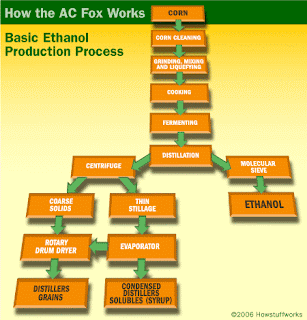
The following post was derived from the University of Rochester (NY) website for press releases . You might ask why I think it might be of interest to you--and if you do, my answer is that ethanol is the wave of the future. Not because it's a good idea, but because the government in all its glory and wisdom is backing this energy play. Already ethanol production is having strong effects on the price of corn and it's only going to get worse--the research detailed here might change all that by allowing ethanol production to be shifted to waste biomass like sugar cane pulp and grass. Researchers at the University of Rochester have identified how genes responsible for biomass breakdown are turned on in a microorganism that produces valuable ethanol from materials like grass and cornstalks. This is very important since most ethanol is now produced from corn which isn't very efficient and also drives up the price of corn--and any animal or food "made" from corn. On th...

global warming and yeast

Image
The title of this post is actually referring to my post yesterday. If you put yeast in a mild sugar solution, say grape juice, they'll use that sugar to create their waste product, ethanol. You see, many organisms that live in liquids have evolved with the assumption that their wastes will dilute out to the point where they won't hurt them. Yeast and ethanol is one example, certain types of bacteria and acetic acid is another example. In the "wild" these organisms have no difficulty doing their thing--but pesky humans enclose the yeast or bacteria in limited spaces and those waste products build up. We do this because we don't have any interest in the bacteria or yeast--it's the waste products that we really want. Sounds kinda gross, huh? Wine and vinegar are created when the microorganisms create so much waste that they kill themselves--at which point humans bottle the resulting liquids and then sell them. Now you might see how I'm making an analogy here ...

Of acids, descaling and my sinuses

Image
I love my humidifier. Since buying it a month ago my sinuses have given me a lot less trouble. Leaning over the unit and directly breathing in the hot moist air has decreased my sinus difficulties in a big way. However, while I do love the humidifier I certainly don't love taking care of it. Particularly not the scale that builds up quite rapidly on the thermal unit in the base. Since the humidifier goes through a couple of liters of water--and since my water is from a well with lots of mineral content--a night, there's a lot of mineral salts building up. I need to descale every week. The typical descaling method is to soak in vinegar. Vinegar is mildly acidic having around 5% acetic acid and a pH of around 3. Traditionally vinegar is produced by allowing bacteria to oxidize a fermented solution, typically wine or hard cider. This process takes considerable time, weeks at least and more often months. Some expensive Balsalmic vinegars are aged for decades. That's acetic acid...

no wheeze, no sneeze cat

Image
Cats. Anyone who's read this blog for a while knows I have a love like-hate relationship with cats. For one thing, they make me sneeze, itch, sometimes even wheeze. The other thing is that a pet is supposed to worship you--gotta love dogs for getting that right--and cats decidedly don't do that. No, not even a little. What brings up this subject of cats and allergies is an article in the January Issue of The Scientist titled Felis Enigmaticus . Cute title. The article lightly reviews the science of producing "knock out" animals and more in-depth goes over the claims of Simon Brodie and his company Allerca . This is the company which made headlines last year with their claim that for $4,000 you could buy a hypoallergenic cat from them in the near future. That claim resulted in Time Magazine awarding Allerca's cat with one of Time's honorable mentions as the Best Discovery of 2006. First of all, it's important to know what a knock out animal is. We use t...

communication skills in prokaryotes

Image
I was reading the February 2007 issue of BioTechniques --doesn't everyone?--and came across something interesting in a profile of a professor at Princeton University. It seems that Dr Bonnie Bassler is very interested in communications issues. From my varied relationships with the fairer sex this seems to be a constant interest with women. However Dr Bassler has worked a twist into this issue. Her work is purely with bacteria. Yes, bacteria. Bacteria and communication issues. Germs can talk?! Who knew! It all started when Dr Bassler went to a lecture which had as its core how certain deep sea bacteria use bioluminescence to signal, a topic now called quorum sensing. I still can't get over bacteria talking. Anyway, Dr Bassler quickly signed up to work in this area of research and has since found that bacteria do communicate in a large and diverse number of ways--the method of communication depending on the environment that the bacteria has adapted to . (or for any IDers out the...

Research, monkeys, and influenza

Image
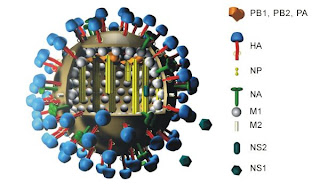
In 1918 there was an outbreak of influenza. That's not unusual. Most winters see a flu going around. That's been true ever since British trading ships began circulating from China back to Europe and the Americas in the late 1700s. You see, birds are the main reservoir for the flu virus and since many birds are migratory, seasonal patterns of flu transmission occur. Many of the flus we experience have their root in shallow Siberian lakes where ducks spend their summer. When the weather turns cold, the ducks migrate to China and infect people with the flu virus, which in turn is transmitted to British sailors and then those sailors would bring it back to Europe with them. Year after year. Most years not many people died but occasionally the virus would be particularly deadly and hundreds of thousands would die in a pandemic, sometimes, like in 1889, over a million would die. But never in human history has there been as deadly a pandemic as the 1918 flu, often called the Spanish F...

Evolution and Hedgehog

Image
I read an article in Seed , a science publication positioned between the serious research journal and the wide circulation science magazines, the other day that sparked my interest. The article focused on the role of hedgehog, a gene I mentioned in a post the other week , in how the Mexican blind cavefish--pictured over there to the left--lost its eyes over time. The article, written by Pz Myers , explores various biological explanations for why a species would lose functionality, such as flightless birds or eyeless fish. The species he focuses on is the Mexican blind cavefish which dwells in underground rivers where they are never exposed to light. The first explanation, economical adaptation , is the one I learned in college, long before DNA analysis was available. This type of adaptation says that it requires a finite amount of time, energy, and effort to build an eye so that over time, if the eye doesn't contribute to the welfare of the species, the eye will cease to be made. T...

Sonic Hedgehog

Image
There's an interesting article on Sonic Hedgehog in the January 18 issue of Nature . I'm used to seeing this gene mentioned when discussing mammalian function or development but not fish--although the article refers to cartilaginous fish only. While both humans and cartilaginous fish are vertebrates we diverged so long ago from the chondricthylans that it's easy to forget that we still share quite a few genes. One of those genes is Shh, commonly referred to as Sonic Hedgehog , pictured over there to the left. Shh, in mammals, encodes a signaling molecule that plays a central role in developmental patterning, especially of the nervous system and the skeletal system. It's highly conserved and mutations in the gene result in serious maladies such as holoprosencephaly type 3. I'm familiar with Sonic Hedgehog due to its being implicated in causing tumors and thus of interest to cancer investigators. Getting back to the article in Nature, it demonstrates how Shh is conse...

angiogenesis and Warburg Effect

Image
I work in cancer research and of late I've been investigating the affects of some chemicals on angiogenesis, particularly as it relates to breast cancer. Now I'm a technician, not a PI, so my nose is to the ground and I often miss the big picture since my concerns are oriented towards the day-to-day research. As a result, I often get tunnel vision and only look at cancer through the prism of my research. In this case that means that I frequently think of cancer as only developing when there's plenty of oxygen available--which is reasonable since as a fast dividing group of cells, a cancer tumor needs lots of energy which would seem to imply oxidative reduction, not glycolysis--which requires sufficient vascularization and thus angiogenesis. However the cancer picture is more complex than that and the Warburg Effect is one example of that. Some tumors actually preferentially grow in the absence of oxygen and use glycolysis as their primary source of energy. They do this by b...

Next by Michael Crichton

Image
Let's start out by my saying that I don't think Crichton's written a real novel in quite some time and this book, Next , is not an exception to that. However I did enjoy reading it and I would recommend it for people with an interest in or fear of genetic / science research. Let me justify my remarks a bit. I think Crichton is a very good writer when he bothers. However he's only got so much time and his creative energy is split in many directions which results in books that are multipurpose. Lost World and Prey were little more than movie scripts spun into books. State of Fear was a polemic on global warming much in the style of Da Vinci Code . Crichton's current book, Next , is a different type of non-novel. This book is like a few Powerpoint slides filled with bulleted points but fleshed out in a fictional fashion. The result is what seems at times to be almost random jumps between thinly described characters--characters which serve mainly to illustrate the ...

Steamy topics: sex and boiling water

Image
Today's post is largely for visitors from Michele Agnew's blog. It's got two parts and you can comment on either side, depending on which you prefer. The topics de jour are sex and science. The sex thing is desire. How often do you actually want to have sex? Now that sorta thing varies on all sorts of variables but still there's a base level that most people rotate around. It can go up or down depending on age, medical condition, season of the year, or more to the point--who you're sharing a bed with. LOL? For me, twice a week seems to be the sweet spot but I'm adaptable. Most women I've known in that way--with the notable exception of someone I shared my last name with temporarily--have been more "lively" so that adaptability has been stressed a number of times. How about you? What floats your proverbial boat? The picture at left is from some survey that compared how many times a year a person had sex with the variable being country of origin. Her...

Genographic Project

Image
Mapping the Origins of Human Migration The Genographic Project is a collaborative project with The National Geographic Society, IBM, and the Waitt Family Foundation being the principal backers. The purpose is to establish what the routes were by which humans populated the planet. As you've probably noticed, we humans can be found pretty much anywere you look--for better or worse--but at some point in time we were in just one place. So, how did we get from that one place to being a plague on the planet everywhere? This project, initially funded with $40 million(US) of private funds, takes buccal samples (swab of cheek cells) from indigenous populations worldwide. The project started in April 2005 and is slated to finish in 2010. Unique to this project is the ability for private individuals to add their buccal samples to the database albeit at a cost of $100(US). These collected cheek cells will be processed which involves DNA extraction, amplification, sequencing, and bioinformati...